My Alexa Has Heard Things. I Gave Her a Month of My Dating Life and She Filed a Report.
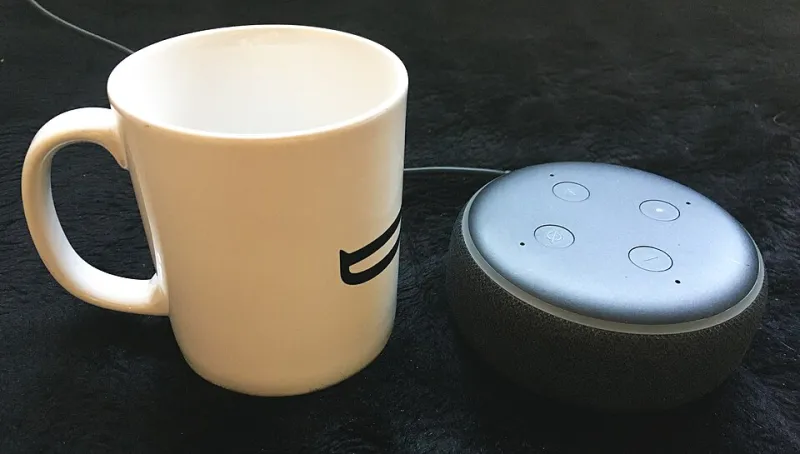
Photo: Pittigrilli, CC BY-SA 4.0, via Wikimedia Commons
There's a moment in every person's life when they realize their smart speaker knows more about them than their mother does. Mine arrived at 1:47 AM on a Tuesday, when I asked Alexa to play 'sad songs for people who peaked in college' and she responded with a level of enthusiasm that felt, frankly, judgmental.
That's when I decided to do something stupid. Something with the same energy as letting a raccoon do your taxes. I gave my smart speaker full access to my dating life for one month and asked it to generate a 'Relationship Compatibility Report.' This is what happened, and yes, I'm in therapy now. (Kidding. The speaker recommended it.)
Week One: The Honeymoon Phase (of Surveillance)
The rules were simple. Every match, every conversation, every playlist I made at midnight — all of it went through the speaker. If I talked about a date, I debriefed her like she was my accountant. "Alexa, log the following: he said he's 'not like other guys' while wearing a Patagonia vest."
By day four, she had enough data to start making connections I wasn't ready for. My Sunday night playlist of choice? Active grief. My most-searched phrase between 2 and 3 AM? "Can you be allergic to a personality?" My most-played song during first dates? "I Will Survive," which I want it noted was NOT intentional, but the algorithm doesn't do coincidences.
Here's the thing nobody tells you about handing your data to a machine: the machine doesn't care about your feelings. There's no social grace. When my friend Dana asks how the date went, I say "it was fine!" When Alexa asks, she has timestamps.
The Financial Audit Nobody Asked For
Because this is Padakuu and we can't help ourselves, let's talk money. My speaker ran the numbers on my dating habits like a hedge fund manager reviewing a failing portfolio, and I want to die.
Total spent on first dates in 30 days: $412.60. Total spent on second dates: $0.00. That's not a dating life, that's a philanthropy. I was out here making seed investments in men who had no intention of going public.
The most damning statistic: I spent $63 on a first date with a man who, per my own search history logged that same week, I had already Googled "is it rude to leave after 20 minutes." The speaker flagged this as "emotional day-trading with borrowed confidence." I've never been so hurt by something that doesn't have a face.
And the ROI on my playlist choices? Spotify says my top genre during dating-app hours is "sad indie folk," which my speaker interpreted — correctly — as "a man who describes himself as an enigma but is actually just tired."
The Compatibility Report: A Reading of the Will
At the end of the month, I asked for the full report. She generated it in seconds, which felt aggressive. Here are the highlights, lightly paraphrased because I refuse to type the exact wording of my own destruction:
On my type: "Based on 23 matches and 11 dates, your stated preference is 'someone spontaneous who loves adventure.' Your behavioral data shows you consistently select men whose primary hobby is talking about a screenplay. Recommendation: date someone boring. You are not equipped for adventure. You own one (1) emergency granola bar from 2021."
On my conversation patterns: "You ask 4x more questions than you answer. You are not conversing. You are conducting interviews for a position you're afraid to fill."
On the 2 AM searches: I will not be sharing these. Some things go in the report, not the article. But she categorized them under a folder titled "Concerning but Common," which honestly should be the name of my memoir.
The final compatibility score against my own dating profile? 61%. "You are more compatible with the version of yourself in your photos than with the person operating the account."
I sat in my kitchen, holding a phone that pays for my speaker, listening to a speaker that pays for nothing, being told I'm catfishing myself. And the worst part? The receipts. Every claim backed by data. Every data point mine. I couldn't even be mad. I was out-argued by a hockey puck with a light ring.
What Our Devices Actually Know About Us
Underneath the comedy, there's something genuinely interesting happening here. Our devices are accidental biographers. We curate ourselves everywhere — LinkedIn, Instagram, dating profiles — but 2 AM search histories don't lie. Playlists don't lie. The $412 in first-date receipts doesn't lie.
We think of dating as chemistry, vibes, fate. But strip it down and it's the biggest financial decision most of us make, wrapped in a personality quiz we're failing on purpose. My speaker didn't tell me anything I didn't know. She just said it without a chaser, the way only a machine can.
The Verdict
I've since revoked her access, mostly because she started suggesting 'focus playlists for difficult conversations' unprompted. But I kept the report. It's saved in a folder called "Growth," which is the same folder where I keep my gym membership cancellation email.
Would I recommend this experiment? Absolutely not. Will I do it again next quarter to see if my metrics improved? My speaker already has it on the calendar.
She says I'm 'trending upward.' From a machine, that's a love letter.